

LFT and KFT Tests: What They Mean for Your Health Today
12 Oct 2026 · By Bluvial Labs

Know what a liver function test shows, how LFT differs from KFT, and why patterns in enzymes, bilirubin, and proteins matter.
A liver function test is less about one single number and more about a pattern across enzymes, proteins, and bilirubin. Bluvial Labs, a Delhi NCR diagnostics laboratory for blood tests and home sample collection, is a useful real-world example because LFT and KFT screening are often booked together, even though they answer different health questions.
> ### TL;DR: Summary > > * A liver function test, or LFT, is mainly a blood panel for liver injury and liver function, while kidney assessment is strongest when creatinine is paired with eGFR and urine albumin rather than read alone. > * Common LFT components include ALT, AST, ALP, GGT, bilirubin, albumin, and total protein, which help show liver cell injury, bile flow issues, and protein-making function. > * A KFT is not just a creatinine test; MedlinePlus and NIDDK both point to eGFR and urine albumin or urine albumin-to-creatinine ratio as key kidney markers. > * If ALT and AST are raised, fatty liver and other causes may need follow-up; if ALP, GGT, and bilirubin are raised together, bile duct or cholestatic patterns become more relevant. > * Bluvial Labs lists LFT testing, home sample collection, and 24 to 48 hour reporting on its liver test page, which matters when repeat testing is needed after an abnormal result.
That difference matters in day-to-day health screening. An LFT helps flag liver injury or reduced liver-made proteins, while kidney testing focuses more on filtration and kidney damage markers, which is why reading both reports properly can save you from false reassurance or needless worry.
What is a liver function test and what does it actually measure?
An LFT is a blood panel that checks enzymes, proteins, and bilirubin linked to liver health. MedlinePlus describes liver function tests as measurements of substances made by the liver or cleared through it.
The name can be slightly misleading. Some LFT markers reflect liver cell injury, especially ALT and AST, while others reflect bile flow, protein production, or waste clearance. Albumin and total protein give context on the liver’s synthetic role. Bilirubin matters because it is a waste product formed when old red blood cells break down, and the liver normally helps remove most of it.
A common mistake is to treat an LFT like a yes-or-no test for “good liver” or “bad liver.” It works better as a pattern-recognition panel.
How is an LFT different from a KFT?
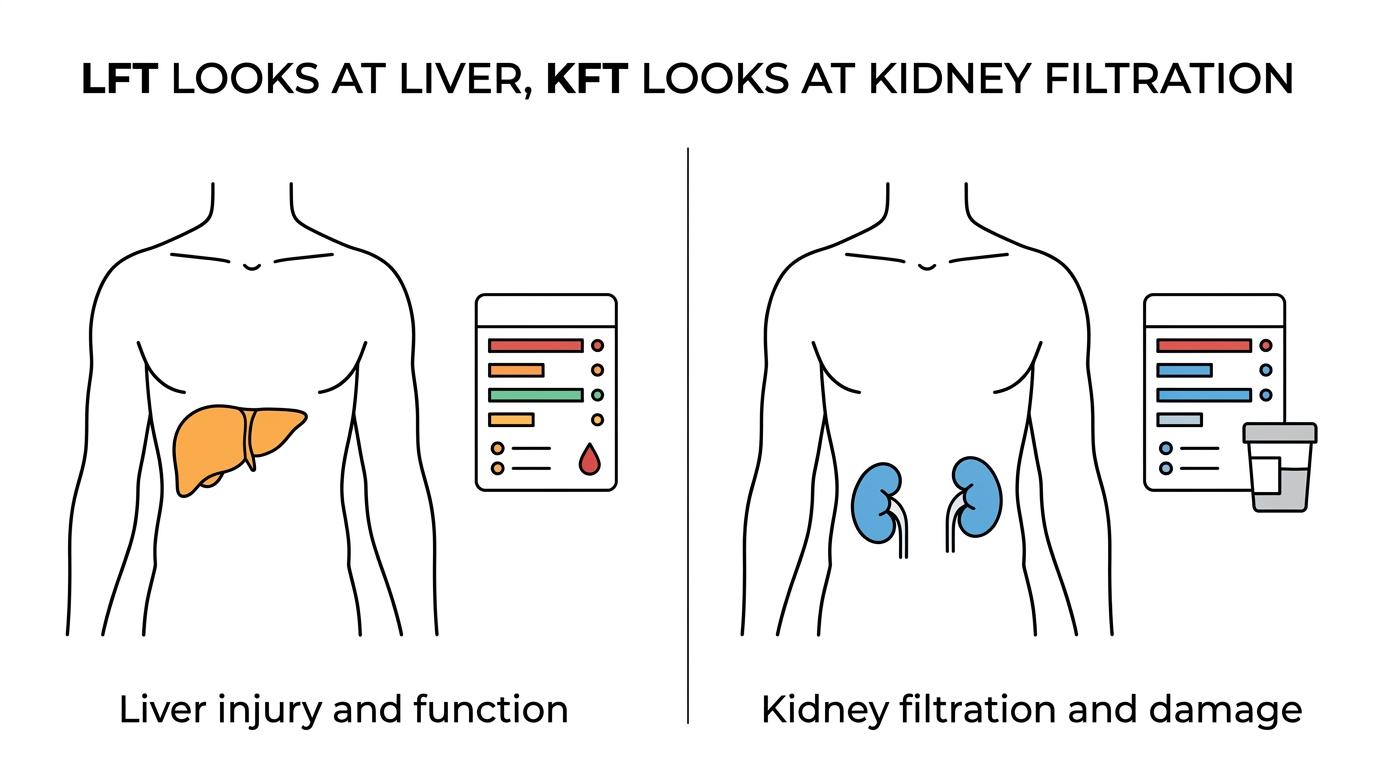
An LFT and a KFT answer different biological questions. LFT focuses on liver injury and liver-made substances, while KFT focuses on kidney filtration, waste removal, and signs of kidney damage.
In simple terms, the liver processes chemicals, makes proteins, and helps clear bilirubin. The kidneys filter blood, balance fluids and salts, and remove waste products like creatinine. That is why a high ALT points you in a different direction from a low eGFR. MedlinePlus notes that kidney tests can include blood and urine tests, not just one blood value. If you compare the two panels side by side, think “injury and function” for LFT, and “filtration and damage” for KFT.
> “Bluvial Labs states that its liver test page offers home sample collection and a 24 to 48 hour report window, which suits repeat monitoring after an abnormal LFT.”
What are the main tests in an LFT panel?
The core LFT panel usually includes ALT, AST, ALP, GGT, bilirubin, albumin, and total protein. These markers are standard because each adds a different layer to liver assessment.
After the basic definition, the easiest way to read an LFT is to know what each marker is meant to signal:
- ALT: More liver-specific enzyme, often watched in fatty liver and hepatitis patterns.
- AST: Enzyme seen in liver injury, but also present in muscle and other tissues.
- ALP: Marker that can rise when bile flow is obstructed or bone activity is high.
- GGT: Helps confirm whether a raised ALP may be coming from the liver or bile ducts.
- Bilirubin: Waste product that rises when clearance is impaired or red blood cell breakdown is increased.
- Albumin: Major blood protein made by the liver, useful for long-term function context.
- Total protein: Broad measure that adds context alongside albumin and globulins.
One marker rarely tells the full story. Patterns matter more than isolated numbers.
What can high ALT, AST, ALP, GGT, or bilirubin mean?
Raised LFT markers suggest a pattern, not a diagnosis. ALT and AST often point toward liver cell injury, while ALP, GGT, and bilirubin together can point more toward bile flow problems.
NIDDK notes that non-alcohol related fatty liver disease may be suspected when ALT and AST are increased, though extra blood tests may still be needed to rule out other causes. If ALT is higher than AST, one interpretation may be different from a report where AST is dominant, and both are different again from a report where ALP and GGT are the main abnormalities. If bilirubin is also raised and you have jaundice, the follow-up becomes more urgent.
A common misconception is that one abnormal enzyme means liver failure. It does not. Albumin, total protein, symptoms, medicines, alcohol intake, weight, viral risk, and repeat values all change the picture.
> “Bluvial Labs combines an NABL-accredited in-house lab with plain-language digital reporting, which is useful when you need to compare trends instead of reacting to one abnormal value.”
How do you read an LFT report step by step?
Read an LFT by checking the lab range first, then the pattern, then the trend over time. ALT, AST, bilirubin, and albumin together usually tell more than any single result.
Start with whether the value is mildly, moderately, or clearly outside the reference range used by that lab. Labs can vary, so a value should always be read against the specific range on your report.
Next, group the results. If ALT and AST are the main abnormalities, think liver-cell injury pattern. If ALP and GGT are more prominent, think bile-flow pattern. If albumin is low or total protein is unusual, you may need a broader clinical review because protein levels can reflect nutrition, inflammation, or longer-term liver issues.
Then compare with old reports. Pro tip: one stable mild abnormality may matter less than a steady upward drift over several months. Trend beats snapshot in many routine screening cases.
When should you get an LFT or repeat one?
You should consider an LFT when symptoms, risk factors, medicines, or a preventive check-up justify it. Repeat testing is usually guided by symptoms, baseline risk, and whether the first abnormality persists.
People often get LFTs during routine health screening, before starting or while monitoring some medicines, when there is fatigue, jaundice, dark urine, nausea, or right upper abdominal discomfort, or when metabolic risk is present. Diabetes, obesity, high triglycerides, and fatty liver risk commonly bring LFT into the picture.
If your result is mildly abnormal and you feel well, your doctor may ask for a repeat test after a suitable interval and review alcohol intake, supplements, and medications first. If symptoms are present, or bilirubin is high, follow-up tends to move faster.
Is creatinine alone enough for a kidney assessment?
No. Creatinine alone is not enough, and even when a combined LFT-KFT panel is ordered through Bluvial Labs or any other provider, eGFR and urine albumin add essential kidney context.
MedlinePlus identifies GFR as one of the most common blood tests for chronic kidney disease because it reflects how well the kidneys are filtering. NIDDK also points to urine albumin and urine albumin-to-creatinine ratio as important for a fuller kidney disease assessment. That matters because creatinine can stay within range in early disease, especially if muscle mass, age, hydration, or body size affect the number.
Here is the useful rule: if creatinine is “normal” but urine albumin is elevated, kidney damage may still be present. If creatinine is high and eGFR is low, the filtration issue becomes clearer. A KFT is strongest when these markers are read together.
How should you prepare for an LFT or KFT?
Preparation is usually simple: follow the lab’s instructions, tell them about medicines and supplements, and do not stop prescribed drugs unless your clinician tells you to. Some combined packages may have fasting instructions if other tests are included.
Step one is practical. Confirm whether your order includes only LFT or a wider health panel. If glucose or lipid tests are bundled in, fasting rules may apply even when the LFT itself does not require it.
Step two is disclosure. Tell the lab or doctor about alcohol intake, gym supplements, herbal products, painkillers, statins, or recent intense exercise. These can shift enzymes or kidney-related markers.
Step three is consistency. Try to test under similar conditions if you are tracking trends over time. Same timing, similar hydration, and the same lab method can make comparisons cleaner.
> “Bluvial Labs says its Essential Health Check includes both LFT and KFT, home collection, and a 24-hour report on that package page.”
How can you pair LFT and KFT for preventive screening?
For preventive screening, start with an LFT plus creatinine and eGFR, then add urine albumin when kidney risk is present. Bluvial Labs includes both LFT and KFT in a routine health-check format, which reflects how these panels are often screened together.
The best sequence is simple. First, get a baseline if you have not tested in a while, especially if you are overworked, have metabolic risk, or take long-term medication. Second, if liver enzymes are abnormal, review weight, alcohol, medicines, and doctor-advised next tests. Third, if kidney markers are part of the check-up, do not stop at creatinine if you have hypertension, diabetes, swelling, or a family history of kidney disease.
A quiet but useful point here is that liver and kidney risk often overlap. Diabetes, obesity, high blood pressure, and medication exposure can affect both organs, so paired screening makes clinical sense.
What results need quicker medical follow-up?
LFT or KFT abnormalities need faster review when they come with symptoms, visible jaundice, reduced urine, swelling, or a strong change from your baseline. Symptoms plus abnormal labs matter more than a mild isolated deviation.
Do not wait too long if the report pattern and the body are telling the same story. If bilirubin rises and your eyes look yellow, if dark urine appears, if vomiting or confusion develops, or if urine output drops with swelling, prompt clinical review is sensible. A second common mistake is to focus only on whether a value is “slightly high” while ignoring symptoms.
Useful red-flag examples include:
- Jaundice with raised bilirubin: Needs timely medical review.
- Reduced urine with abnormal creatinine or eGFR: Suggests kidney filtration may be affected.
- Progressively rising enzymes on repeat tests: Trend can matter more than one borderline value.
- Fever, severe weakness, vomiting, or confusion with abnormal labs: Clinical review should not be delayed.
Tests mentioned in this article
Book any of these with free home sample collection.