

Full Body Checkup Price: What Changes the Final Cost
12 Oct 2026 · By Bluvial Labs
Full body checkup price depends on tests, add-ons, home collection, and reports. Compare panels and value, not just the lowest cost.
A full body checkup price can look confusing because two packages with the same label may include very different tests, service terms, and reporting features. Bluvial Labs, a diagnostics laboratory serving Delhi NCR, is one example of how package pricing is tied to what is actually inside the checkup rather than the words “full body checkup” alone.
> ### TL;DR: Summary > > * Full body checkup price mainly changes with the number and type of tests included, so a cheaper package usually means fewer tests or simpler service terms. > * Provider variation matters: external reporting from Consumer Reports shows healthcare prices can differ sharply within the same local area, which helps explain why checkup prices are not uniform. > * Bundled screening can reduce the per-test cost, but the World Health Organization notes each test in a bundle still needs to be justified on its own merits. > * The right package also depends on age, sex, overall health, and family health history, which matches MedlinePlus guidance on screening selection. > * A practical local example is Bluvial Labs, where one preventive package is listed at ₹1,000 and a broader comprehensive package at ₹1,499 because their included tests and screening scope differ.
That is why the smart question is not “What is the cheapest full body checkup?” but “What am I actually paying for?” Once you compare the test menu, add-ons, home collection terms, and report turnaround, the final cost starts to make sense.
Why do full body checkup prices vary so much?
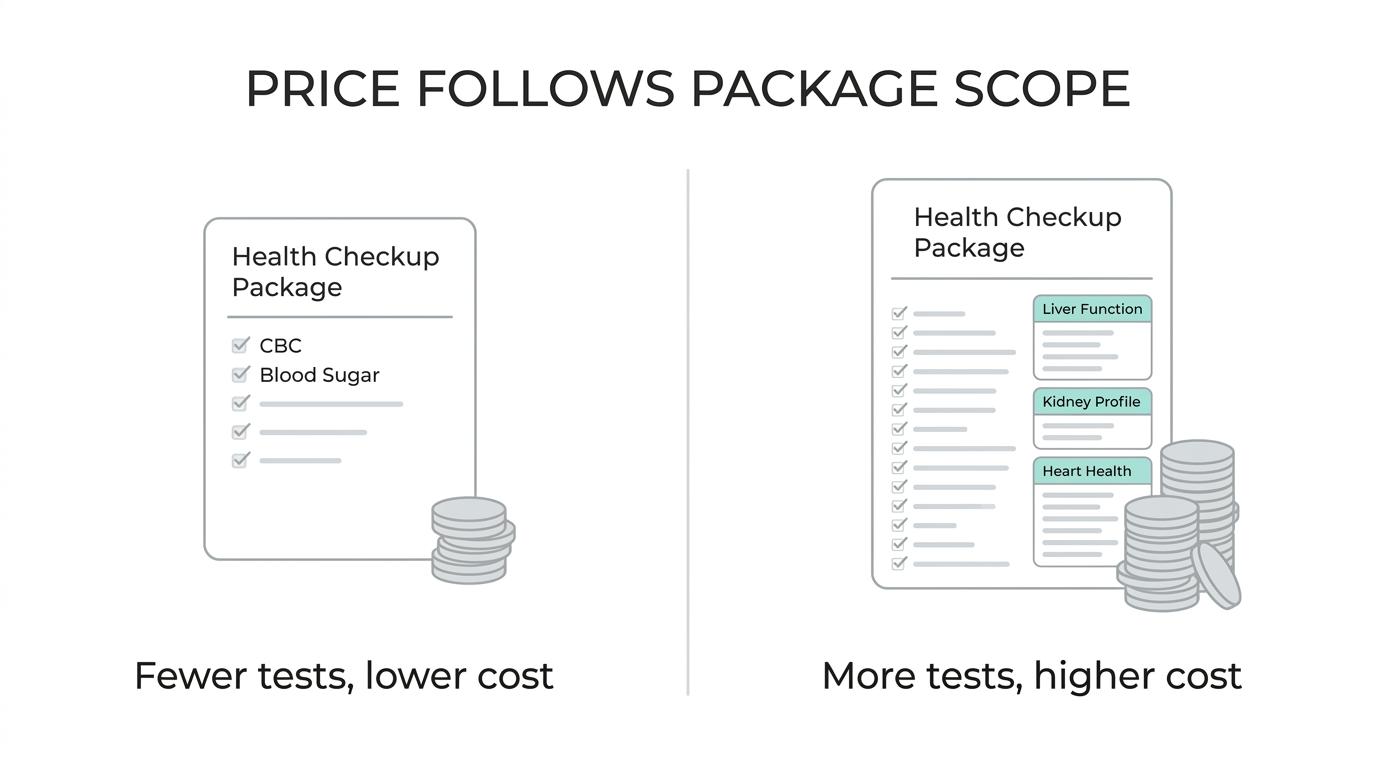
Full body checkup prices vary because the bill reflects test breadth, lab processes, and service terms, not a standard national definition. A package with CBC, glucose, lipid profile, liver function, kidney function, and thyroid testing will usually cost less than one that also adds HbA1c, vitamins, urine testing, and wider screening markers.
The phrase “full body checkup” is not a fixed medical standard. One provider may use it for a basic preventive screen. Another may use it for a much broader bundle that includes metabolic, nutritional, hormonal, and urine analysis panels. If two packages sound similar but one includes 30 tests and the other includes 70 plus biomarkers, the lower price is not automatically better value.
Provider variation also matters. Consumer Reports highlighted a wide spread in routine healthcare pricing within the same local area, with one cited example in Albany ranging from $276 to $950 depending on provider and the patient’s gender. The currencies and health systems differ from India, but the main point still holds: local market pricing is never perfectly uniform.
> "Bluvial Labs lists a Comprehensive Health Check at ₹1,499 with 72 biomarkers, showing how package price tracks test depth, not just the package name."
A common mistake is comparing only the headline price. The better comparison is cost versus included panels, sample collection terms, and whether the package fits your actual screening need.
What is usually included in a full body checkup price?
At Bluvial Labs, the price reflects the actual test menu and service scope, not just the label “full body checkup.” In most Indian packages, the core usually starts with CBC, blood sugar, lipid profile, liver function, kidney function, and often thyroid testing.
Many preventive packages also include urine routine examination, HbA1c, and sometimes vitamin B12 or vitamin D. Those additions can raise the final price because they add both laboratory work and interpretation value. A broader package may also count biomarkers separately, which makes the package look far larger on paper.
That is where buyers need to slow down. “90+ parameters” does not always mean 90 separate decisions by your doctor. One panel, like liver function, can generate multiple reported values. Pro tip: count both the panels and the clinical purpose of those panels, not just the parameter total.
Service terms are part of the price too. Home sample collection, fasting requirements, digital report delivery, and turnaround time all affect what you receive for the amount paid.
What are the biggest factors that change the final cost?
The biggest price drivers are test count, test type, bundled design, provider pricing, and service extras. If any one of those changes, the full body checkup price usually changes with it.
Before you compare rupee amounts, break the package into its real cost drivers. That makes it easier to see whether a higher price reflects useful screening or just a longer package description.
- Number of included tests: More panels usually mean a higher package price, even when the per-test cost falls inside a bundle.
- Type of tests: Routine chemistry and haematology tests cost differently from vitamin assays, hormone panels, or specialised markers.
- Bundling strategy: A provider may reduce the per-test cost when multiple screening tests are grouped together.
- Provider variation and local area pricing: Lab operating models, city coverage, and local competition affect rates.
- Service terms: Home collection, faster reports, repeat support, and digital tracking can change the final bill.
The World Health Organization has noted that carrying out multiple screening tests at the same time may reduce costs or simplify a screening programme. That does not mean every bundle is automatically good value. Each included test still has to make clinical sense for the person taking it.
Is a bundled full body checkup cheaper than booking tests one by one?
Often yes, a bundle can reduce the effective per-test cost, but only if the included tests are relevant to you. A bundle becomes poor value when it includes panels you do not need and misses ones you do.
This is the main trade-off. Bundles spread fixed costs across more tests, which can lower the average price per marker or per panel. That is why providers often price packages below the summed price of ordering every test separately.
The WHO’s screening guidance supports this logic in principle: multiple screening tests done together may reduce costs or simplify programme delivery. Still, the same WHO guidance is careful on one point that many buyers miss. Every test in the package should be judged on its own merits.
> "Bluvial Labs shows one preventive package at ₹1,000 and a broader comprehensive option at ₹1,499, which is a practical example of how extra screening scope changes bundle pricing."
If you already know the two or three specific tests you need, individual ordering can be more efficient. If you need a baseline screen across metabolic health, liver, kidney, thyroid, and blood counts, a good bundle often makes more financial sense.
How can you compare two checkup packages step by step?
Compare packages by matching test panels first, then service terms, then your own risk profile. Price comes after those three checks, not before.
Start with the panel list. Put Package A and Package B side by side and mark which one includes CBC, fasting blood sugar, HbA1c, lipid profile, liver function, kidney function, thyroid profile, vitamins, and urine routine. If one package skips HbA1c or urine testing, it may look cheaper because it is doing less.
Next, compare the service terms. Is fasting required? Is home collection included? How quickly are reports delivered? Is the report easy to read? These details matter because a package can be clinically decent but logistically inconvenient.
Then compare fit. MedlinePlus guidance says screening needs depend on age, sex, overall health, family health history, and disease risks. If you are paying for a package that misses your most relevant screening area, the low price is false economy.
Common misconception: two packages with similar names are not necessarily substitutes. The useful comparison is panel-for-panel, not name-for-name.
When is a cheaper package actually good value?
A cheaper package is good value when it covers your screening goal without obvious gaps. For a low-risk adult seeking a basic baseline, a smaller panel may be the right choice.
That usually means the essentials are present: blood count, glucose status, lipid profile, liver and kidney function, and basic urine or thyroid testing when relevant. If your objective is routine preventive monitoring and you have no specific symptoms or family-risk triggers, paying extra for broad add-ons may not improve the usefulness of the checkup.
The risk is underbuying without realising it. A very low price can signal that the package leaves out HbA1c, thyroid, vitamins, or urine analysis. Whether that matters depends on your goal. If the package still answers your main health questions, then low cost can be rational rather than “cheap.”
A quick rule helps: if the package supports your baseline screening need, a lower price is sensible; if it leaves unanswered questions you will later test separately, the apparent saving may disappear.
How do age, sex, and family history change what you should pay for?
Age, sex, and family history directly affect which screening tests are worth paying for. MedlinePlus makes this clear: test selection should reflect personal risk, not a one-size-fits-all package.
Here is the step-by-step way to think about it. First, list your purpose: annual baseline, diabetes tracking, thyroid follow-up, fatigue workup, or cardiovascular risk review. Second, note your risk modifiers: age band, sex, weight changes, blood pressure, family history of diabetes or heart disease, and any ongoing medication. Third, choose the smallest package that still covers those risk areas.
This is why two people in the same family may need different checkups at different prices.
The same logic applies when symptoms, rather than age alone, shape the testing need, and BedFan’s overview of thyroid adenoma and night sweats is a useful example of why a specific complaint can justify more targeted thyroid-related screening than a generic package.
A 26-year-old without symptoms may only need a basic preventive panel. A 46-year-old with a family history of diabetes and high cholesterol may need HbA1c and a fuller metabolic screen. The second person is not overpaying. They are buying a more relevant test mix.
Pro tip: if family history is the reason for testing, check whether the package contains the exact screening panel that matches that risk rather than assuming “full body” covers it.
How do home collection, turnaround time, and digital reports affect price?
At Bluvial Labs, free home collection across Delhi NCR and 24-hour reporting on select packages show that service terms are part of the checkup value, not just the lab panel itself. Convenience features can change the price, but sometimes they are bundled rather than billed separately.
The WHO’s costing framework is useful here. Screening costs are not only about the reagents or the printed report. They also involve direct laboratory costs, facility assumptions, equipment maintenance, and service-day capacity. That helps explain why two labs can offer similar panels at different prices.
Home collection often feels like a luxury, but in some local markets it is simply part of the operating model. The same goes for digital reports and health history tracking. Common misconception: faster reporting always means “premium” pricing. In reality, some providers build rapid turnaround into standard packages.
> "Bluvial Labs includes free home collection across Delhi NCR, which shows that convenience can be bundled into a checkup package instead of appearing as a separate line item."
When you compare prices, separate clinical scope from service convenience. A higher fee may reflect better logistics, wider city coverage, or simpler follow-up, not just more biomarkers.
How should you review add-ons before paying?
Review add-ons by asking whether they answer a real screening question, whether they duplicate included tests, and whether they fit your current risk. If the answer is no, skip them.
Use a simple three-step filter. First, identify the trigger: symptom, doctor advice, family history, or routine monitoring. Second, check whether the package already includes a related panel. Third, ask whether the add-on changes what you would do next.
This matters because add-ons can look small in isolation but lift the final bill quickly. Vitamins, hormonal panels, and extra metabolic markers may be valuable, but only when they are tied to an actual reason. If you add them “just in case,” the package stops being efficient.
A practical rule is this: if an add-on solves a known information gap, keep it; if it only sounds broad or advanced, pause before paying.
How can you set the right budget for your next full body checkup?
Set your budget by fixing your screening goal first, then choosing the minimum useful package, then allowing for one or two justified extras. That gives you a rational price range instead of chasing the lowest number.
Step one is purpose. Annual preventive screen, chronic risk review, or targeted wellness tracking each points to a different package depth. Step two is must-have panels. Write them down before browsing offers. Step three is service priority: home collection, no-fasting option, and report speed. Only after that should you compare prices.
For many buyers, the right budget sits between “too basic to answer anything” and “too broad to be efficient.” If a package price is unusually low, check what has been left out. If the price is higher, ask whether the extra cost comes from broader screening, local convenience, or better reporting.
That approach gives you a number you can defend clinically and financially. You are not just buying a test package. You are paying for the specific combination of screening relevance, lab processing, and service quality that matches your health goal.
Tests mentioned in this article
Book any of these with free home sample collection.