

CBC, ESR, or CRP: Picking the Right Fever Profile Test
19 Oct 2026 · By Bluvial Labs
Learn how to choose the right fever profile test with CBC, ESR and CRP, and when each offers the most useful clues in fever workups.
Fever workups often start with a simple question: should you order a CBC, an ESR, a CRP, or a bundled fever profile? Bluvial Labs, a NABL-accredited diagnostics laboratory serving Delhi NCR, is relevant here because one of its wellness screenings combines CBC, ESR, and CRP, which reflects how these tests are commonly used together in real practice.
> ### TL;DR: Summary > > * The right fever profile is usually not CBC or ESR or CRP alone. In most fever workups, CBC, ESR, and CRP are complementary tests that answer different parts of the same question. > * CBC is best for blood-cell clues such as white blood cell changes, platelet issues, or anaemia; CRP and ESR are inflammation markers and do not identify the exact cause by themselves. > * CRP is generally more useful than ESR when you want a faster read on active inflammation, while ESR is more of a supporting marker and is often interpreted with other tests. > * Bluvial Labs includes CBC, ESR, and CRP qualitative together in one Wellness Screening, which matches the common clinical pattern of pairing cell counts with inflammation markers rather than relying on a single number. > * If fever has no red-flag symptoms and no localising signs, testing is not always needed immediately. If fever is persistent, severe, or linked with concerning symptoms, these blood tests often need to be read alongside clinical review and other targeted tests.
That matters because people often expect one report to “show the infection.” It rarely works that way. CBC can hint at infection or inflammation, while ESR and CRP show that inflammation is present, but the final interpretation still depends on symptoms, duration, examination, and sometimes other tests.
What is a fever profile test and can one blood test diagnose the cause?
No single blood test can diagnose the cause of every fever. In practice, CBC, ESR, and CRP each answer a different question, and Bluvial Labs groups them together in one screening because blood-cell changes and inflammation markers are more useful together than alone.
A fever profile is not one universal standard panel. It is usually a practical combination of tests chosen to answer three broad questions: Is there evidence of inflammation? Are blood-cell counts abnormal? Is there anything that points toward infection severity or another underlying problem?
Merck Manual notes that CBC is commonly done when serious illness is suspected, yet it also points out that CBC has low sensitivity and specificity for diagnosing serious bacterial infection. That is a useful reality check. A common misconception is that more blood tests automatically reveal the source of fever. They do not. A fever profile is a starting point, not a final diagnosis.
> “Bluvial Labs includes CBC, CRP qualitative, and ESR in one Wellness Screening because fever evaluation often needs both blood-cell data and inflammation markers.”
So, if a person has a short-lived fever without alarming features, observation at home may still be reasonable. If the fever is ongoing, recurrent, or paired with worrying symptoms, a profile that combines CBC with ESR and CRP gives a broader first look.
Should you choose CBC, ESR, or CRP first for fever?
If you must start with one test, CBC is usually the broadest first-line choice. CRP is often the more useful inflammation add-on for active fever, while ESR is usually a supporting marker rather than the main decision-maker.
CBC is valuable because it measures blood components directly: white blood cells, red blood cells, haemoglobin, haematocrit, and platelets. Mayo Clinic notes that a white blood cell count higher than usual is often linked to infection or inflammation. That makes CBC a good first step when you want a broad screen rather than a narrow inflammation marker.
CRP, according to MedlinePlus, measures how much inflammation is in the body. It can be helpful in people with fever or chills and may support treatment decisions in sepsis. ESR also shows ESR inflammation, but MedlinePlus is clear that an ESR test alone cannot diagnose what is causing that inflammation.
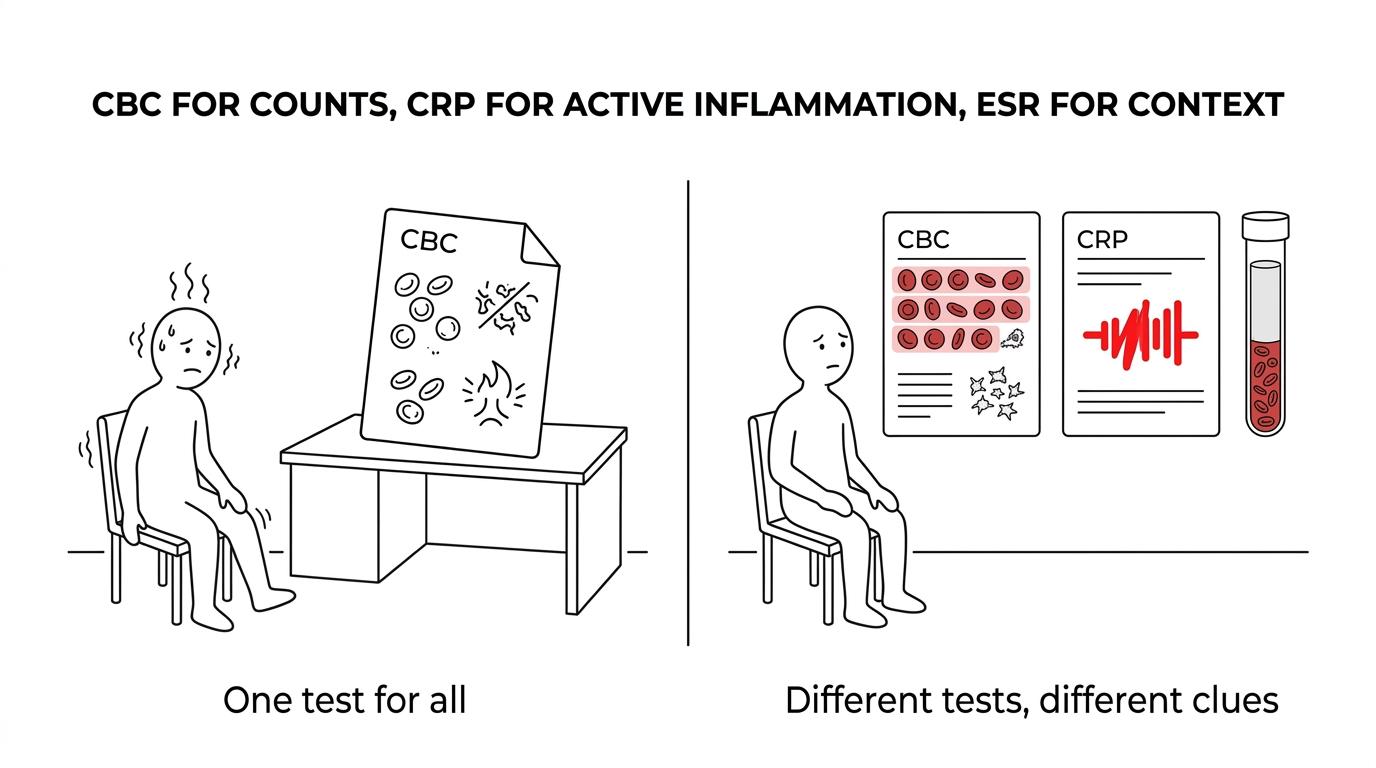
Here is the practical distinction. If the main question is, “Are blood counts abnormal in a way that changes urgency?”, choose CBC. If the question is, “Is there active systemic inflammation right now?”, CRP is often more informative than ESR. If the concern is a longer-running inflammatory picture, ESR can still add context. A common misconception is that a high CRP proves bacterial infection. It does not. CRP can rise in viral infections, autoimmune disease, lung disease, smoking exposure, and other inflammatory states.
What fever profile options are most practical for adults and families?
The most practical fever profile options balance breadth, speed, and clinical usefulness. In real-world testing, bundled CBC plus inflammation markers often make more sense than ordering ESR or CRP in isolation.
Before choosing, it helps to think in terms of intent. Are you screening for general abnormalities, checking active inflammation, or following up persistent fever? That intent changes the right panel.
- Bluvial Wellness Screening: Includes CBC, CRP qualitative, and ESR together, plus fasting glucose, TSH, total protein, albumin, calcium, and vitamin D3; listed at ₹799, with no fasting and report delivery in 24 hours.
- CBC only: Best when you want a broad first look at white blood cells, haemoglobin, and platelets.
- CBC plus CRP: Often sensible when fever is present and you want both blood-count clues and a faster inflammation marker.
- Doctor-directed fever workup: Best when symptoms point to a likely source and additional tests are needed, such as urine, throat, chest, or disease-specific testing.
The trade-off is simple. A smaller panel may be cheaper and easier to interpret, but it can miss context. A broader panel gives more clues, yet it still cannot replace clinical judgement.
How do you pick the right fever profile step by step?
The right fever profile depends on duration, severity, and symptom pattern. If fever is mild and brief, monitoring may be enough; if it is persistent or concerning, CBC with inflammation markers becomes more useful.
A practical choice becomes easier when you move in order instead of chasing isolated numbers.
- Start with the fever pattern: note how high it is, how many days it has lasted, and whether it is continuous, intermittent, or recurrent.
- Check for localising symptoms: cough, burning urination, loose motions, rash, severe body pain, or abdominal pain can point toward other targeted tests.
- Decide what question the blood test should answer: CBC for blood-cell abnormalities, CRP for active inflammation, ESR for supporting context.
- Use a combined profile when uncertainty is high: if symptoms are non-specific, CBC plus CRP and ESR is usually more informative than one test alone.
A practical tip is to avoid ordering ESR just because it is familiar. In acute fever, CRP is often the more responsive marker. ESR is still helpful, but it is rarely the only number you need.
How does CBC differ from ESR and CRP in fever evaluation?
CBC measures blood cells directly, while ESR and CRP measure inflammatory activity indirectly. That is why CBC can show clues about infection or anaemia, but ESR and CRP mainly tell you that inflammation exists, not what is causing it.
CBC is about countable components. White blood cell count may rise or fall. Platelets may be high or low. Haemoglobin may suggest anaemia, blood loss, or chronic disease effects. These details can shift clinical thinking quickly.
CRP and ESR sit in a different category. CRP is an acute-phase reactant made by the liver. ESR reflects how quickly red blood cells settle in a tube, which rises in many inflammatory states. Both are useful, but neither identifies a pathogen or a precise diagnosis by itself.
This is where trade-offs matter. CBC gives wider biological detail, yet Merck notes it is not reliable enough on its own to diagnose serious bacterial infection. CRP is faster-moving and often better for tracking active inflammation. ESR is slower and can remain raised even when the acute phase is settling. A good rule is this: if you want breadth, start with CBC; if you want current inflammatory intensity, add CRP; if you want supportive context, include ESR.
How should you read CBC findings when fever is present?
CBC results should be read as patterns, not verdicts. White blood cells, neutrophils, lymphocytes, platelets, and haemoglobin each add context, but no single CBC line can confirm the cause of fever.
Mayo Clinic points out that a complete blood count can show when cell counts are higher or lower than standard results. In fever, the most watched number is often the white blood cell count, yet even that needs context. Age, medicines, dehydration, and underlying illness can shift it.
- White blood cell count: Higher-than-usual values often support infection or inflammation, but do not identify the source.
- Neutrophil pattern: A neutrophil-predominant picture can support a bacterial process when symptoms fit.
- Lymphocyte pattern: A relative lymphocyte pattern may fit some viral illnesses, though it is not diagnostic.
- Platelets and haemoglobin: These add clues about severity, bleeding risk, chronic disease, or other parallel issues.
A useful caution is that a “normal” CBC does not rule out illness. Early infection, mild viral illness, or non-infectious fever can still be present even when the report looks close to normal.
How do ESR and CRP compare when inflammation is suspected?
CRP is usually the sharper marker for current inflammation, while ESR is slower and more affected by background factors. If the question is “what is happening now?”, CRP often carries more weight than ESR.
MedlinePlus says CRP measures how much inflammation is in the body, and NHS inform notes that CRP is produced by the liver. Because it behaves like an acute-phase reactant, CRP tends to rise and fall more quickly than ESR when inflammation starts or settles.
ESR is still useful, just in a different way. It can support diagnosis or monitoring in conditions associated with inflammation, but MedlinePlus is clear that ESR alone cannot tell you which condition is responsible. ESR can also be influenced by factors beyond acute infection, including conditions that affect red blood cells.
A practical tip is to value trends over one isolated number. If CRP drops on repeat testing, that often tells you more about inflammatory direction than one single result. A common misconception is that a normal ESR rules out significant illness. It does not, especially early in the course.
How should you prepare for a fever profile and what happens after sample collection?
With Bluvial Labs, this fever-related screening does not need fasting, and home sample collection across Delhi NCR can make testing easier when rest matters. Most CBC, ESR, and CRP blood draws are simple venous samples, but timing and follow-up still matter.
Preparation is usually straightforward, though the goal is not just giving blood. The goal is making the result interpretable.
- Check whether the ordered panel needs fasting: this package does not, which avoids unnecessary delay.
- Share current medicines and recent infections: steroids, antibiotics, and existing inflammatory conditions can affect interpretation.
- Note fever timing and symptoms: tell the clinician or phlebotomist if chills, rash, cough, or urinary symptoms are present.
- Keep the report for comparison: repeated CBC, ESR, or CRP values are often more useful than one stand-alone result.
Once the sample is collected, the next step is not to stare at one abnormal line. Read the whole report, compare with symptoms, and decide whether a doctor-directed follow-up is needed. That matters even more when CRP or ESR is raised without a clear source.
> “Bluvial Labs lists no fasting for this screening and digital report delivery in 24 hours, which is practical when fever testing needs quick follow-up.”
A practical tip is to preserve old reports. Trend data can show whether inflammation is new, improving, or persistent, and that often changes the next medical step more than a single result does.
When do fever profile results need other tests or urgent medical review?
Fever profile results need escalation when symptoms are severe, localising, or clinically out of proportion to the blood report. CBC, ESR, and CRP are useful clues, but they do not replace urgent assessment when red flags are present.
If fever comes with breathlessness, confusion, dehydration, chest pain, very low urine output, persistent vomiting, a new rash, or marked drowsiness, medical review should not wait for a routine blood panel. MedlinePlus notes that CRP can help with treatment decisions in sepsis, which is a reminder that some fever states require urgent clinical judgement, not only lab interpretation.
The same applies when the report is non-specific. A raised CRP with a fairly ordinary CBC does not tell you where the problem is. A high ESR does not tell you whether the cause is infection, autoimmune disease, or another inflammatory process. If symptoms point to a source, other tests may be more decisive: urine testing for urinary symptoms, chest imaging for respiratory symptoms, or disease-specific testing when advised by a clinician.
If the fever persists despite apparently modest blood abnormalities, that is also a signal. A separate explainer from BFan on infection-related night sweats makes a similar point: systemic symptoms such as drenching sweats can matter as much as the lab pattern when deciding how quickly a fever needs review.
Tests mentioned in this article
Book any of these with free home sample collection.