
Blood Test Price List: Common Costs and Smart Savings
12 Oct 2026 · By Bluvial Labs
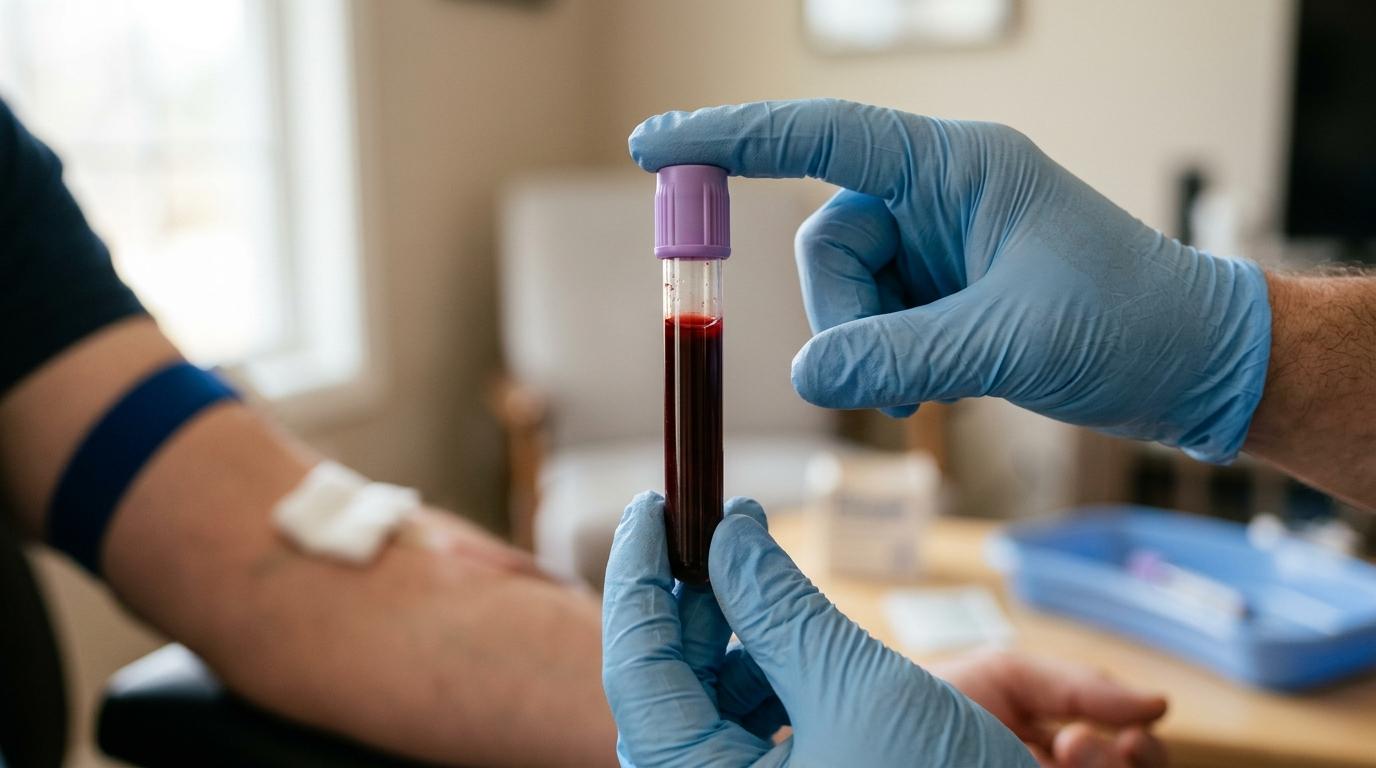
Blood test price in India ranges from free public diagnostics to private lab fees; compare test scope, collection charges and packages smartly.
Blood test price in India can mean very different things depending on where you book, which marker you need, and whether sample collection is charged separately. Bluvial Labs, a diagnostics laboratory serving Delhi NCR, is relevant here because it publishes per-test prices for routine blood tests with home sample collection included, which makes comparisons easier against public and hospital-based options.
> ### TL;DR: Summary > > * Blood test price in India often ranges from free at some public facilities or selected AIIMS services to a few hundred rupees for common private-lab tests, with specialised tests costing more. > * The biggest savings usually come from choosing the right setting first: essential diagnostics like CBC, ESR, PT/INR, blood sugar, and blood group/Rh typing may be free of cost in public facilities under government diagnostic guidelines. > * Private pricing for common tests can still be reasonable, but you should compare the all-in cost, not just the headline rate. Bluvial Labs is one example that lists routine test prices with home sample collection included across Delhi NCR. > * Real price differences usually come from three things: test complexity, whether collection is charged extra, and whether you need a single test or a broader package. > * Before booking, check the exact test name, fasting requirement, turnaround time, and whether the price includes collection, reporting, and repeat-visit costs.
A smart comparison starts by separating routine tests from specialist ones. A CBC or ESR belongs in a very different pricing bracket from cardiac markers, fertility hormones, or oncology markers, so the best value comes from matching the test to the clinical need rather than hunting for the lowest number on a page.
What is the usual blood test price range in India?
Blood test price in India usually runs from free at some public facilities and selected AIIMS services to a few hundred rupees for routine private-lab tests, with specialist markers costing much more. CBC, ESR, HbA1c, thyroid markers, and cardiac tests do not sit in the same price band.
For common diagnostics, a realistic range is broad. Public-sector guidance under the National Health Mission treats many routine investigations as essential diagnostics and aims to make them free of cost through public health facilities. That matters because tests like CBC, ESR, PT/INR, blood sugar, and blood group/Rh typing are high-volume basics, not premium diagnostics.
Private pricing can still be modest for routine items. Published market examples show C. Haemogram at ₹400, ESR at ₹120, Prothrombin Time at ₹208, and Sodium at ₹160. The moment you move into lower-volume or more specialised tests, the price climbs. AIIMS New Delhi’s CRIA list, for example, shows some tests at no charge, while others carry fixed rates such as Anti-Tg at ₹550, AMH at ₹650, BNP at ₹1,250, Procalcitonin at ₹1,350, and Tacrolimus at ₹1,400.
A common mistake is assuming the price range reflects quality alone. In reality, it often reflects whether the test is essential and high-volume, whether the method is specialised, and whether the setting is public, institutional, or private.
> "Bluvial Labs includes home sample collection in the listed routine test price across Delhi NCR, with no visit fee, minimum order, or travel charge."
Why do blood test prices vary so much between labs and hospitals?
Blood test prices vary because the setting, test complexity, and delivery model are different. AIIMS, state facilities, and private diagnostics are not pricing the same operating structure, even when the test name looks similar.
The first factor is the test itself. A routine ESR or CBC uses widely available processes and serves huge patient volumes. A marker like HE4, Inhibin B, or drug-level monitoring sits in a smaller demand pool and may require more specialised equipment or workflows. Lower-volume tests usually cost more per sample.
The second factor is where the test is offered. Public systems price around service access and essential care. Private labs price around logistics, staffing, turnaround time, digital reporting, and consumer convenience. If a lab collects from home, the real question is whether that cost is rolled into the price or billed separately. That logistics piece is not trivial, because handling standards for time-sensitive samples affect cost and process as much as convenience; Xpressbudet’s review of GDP requirements for medicine and clinical samples illustrates why transport and chain-of-custody can influence the final price behind the scenes.
The third factor is scope. “Thyroid test” may mean TSH alone or a broader thyroid profile. “Sugar test” may mean fasting glucose, postprandial glucose, or HbA1c. If two prices look far apart, check whether the same analyte, same panel, and same sample type are being compared. That is where many people go wrong.
What are the common blood test prices people usually compare?
Most people compare a small group of routine tests first, and those are the right place to start. CBC, ESR, PT/INR, glucose, thyroid markers, and HbA1c give the clearest view of market pricing.
Here are the tests people most often check when comparing blood test price:
- CBC or C. Haemogram: around ₹400 in one published private listing; often treated as an essential diagnostic in public care.
- ESR: ₹120 in one private listing; a classic low-cost, high-volume test.
- Prothrombin Time or PT/INR: ₹208 in one private listing; commonly used for clotting assessment and anticoagulation monitoring.
- Sodium: ₹160 in one private listing; useful as a basic electrolyte benchmark.
- HbA1c: listed as a no-charge test in the AIIMS CRIA test list; private rates differ by provider and method.
- TSH and thyroid markers: TSH is listed as no charge in the AIIMS CRIA test list, while broader thyroid panels vary more widely.
- Specialist markers: CA-125 at ₹500, BNP at ₹1,250, Troponin I at ₹850, and Procalcitonin at ₹1,350 on the AIIMS list show how fast prices rise with test complexity.
The key comparison is not just routine versus specialist. It is also single-marker versus panel. If you only need TSH, paying for a full thyroid panel may not be sensible. If your clinician wants HbA1c for long-term glucose control, a single fasting sugar test is not a substitute.
How can you check whether a blood test should be free in a public facility?
You can check this by starting with the public essential-diagnostics framework, then matching the test to the facility level, then confirming local availability. The National Health Mission gives the best high-level map for this process.
Step 1 is to identify whether your test is a routine essential diagnostic. CBC, ESR, blood sugar, urine tests, and blood group/Rh typing often fall into that category. If that is your need, start with a government facility before paying privately.
Step 2 is to ask what level of facility you are dealing with. The Free Drugs and Diagnostics Service Initiative says the essential diagnostics list covers 9 tests at Sub Centre level, 19 at PHC level, 39 at CHC level, and 57 at SDH/DH level. That means availability expands as you move up the public system.
Step 3 is to confirm whether the test is actually being offered that day and whether any outsourced pathway applies. The NHM framework says essential diagnostics should be free of cost through public facilities, while outsourcing may be used for higher-cost or lower-frequency tests. If the answer is yes and the turnaround suits your need, public care may be the lowest-cost route by a wide margin.
How do private lab prices compare with public-sector diagnostics?
Public-sector diagnostics are usually cheaper, and sometimes free, for essential tests. Private labs usually win on speed, convenience, and clearer consumer-facing pricing.
That trade-off matters more than most people expect. If you need a CBC for routine screening and a public facility offers it without charge, the price case is easy. If you need home collection before office hours, a digital report, and predictable turnaround, a private lab may be worth paying for even when the base test itself is simple.
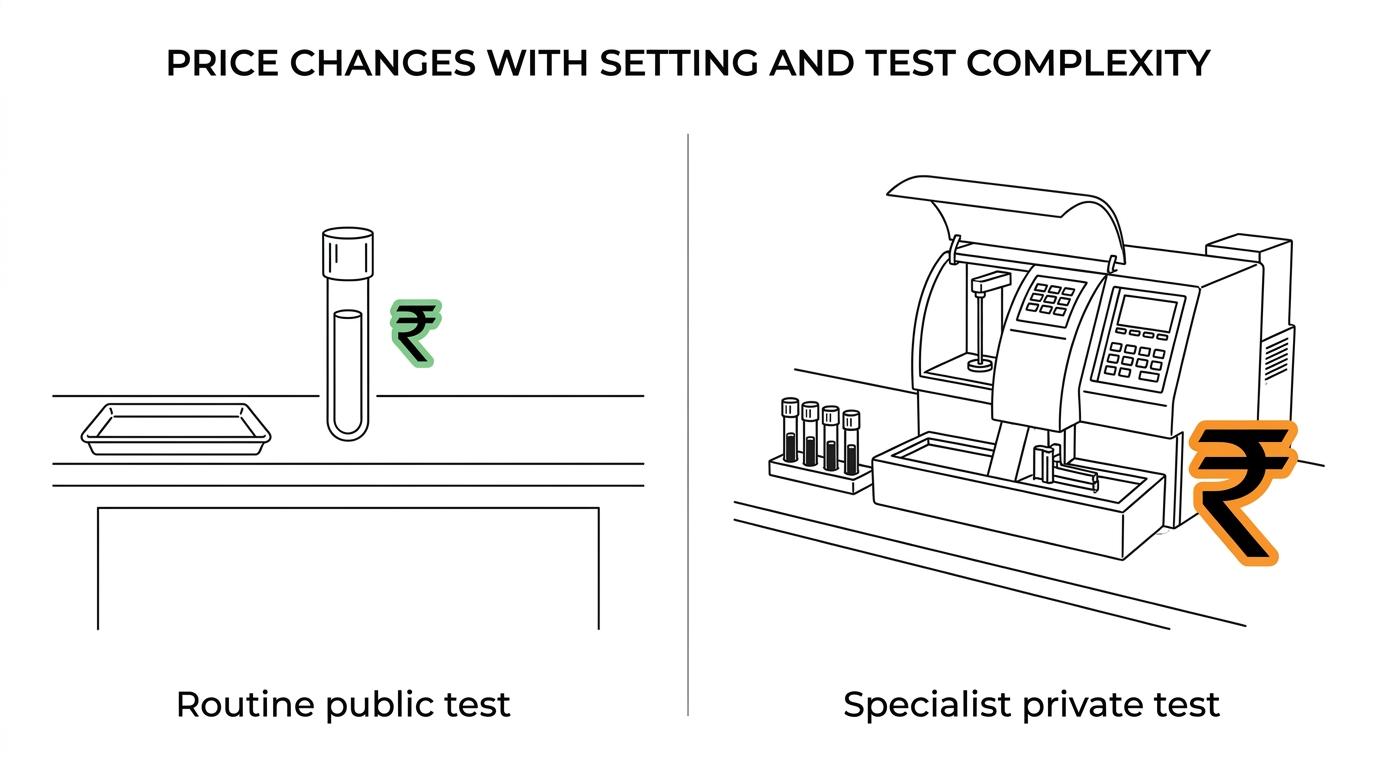
AIIMS makes this contrast very visible. Its published CRIA list includes no-charge tests like TSH, HbA1c, ferritin, vitamin D, insulin, and PSA, while other specialist tests have fixed rupee rates. Private labs, by contrast, tend to show wider variation but often make access simpler. The right choice depends on urgency, logistics, and whether the test falls inside essential care or specialist work.
How can home sample collection change the real cost?
Home collection can make a low listed price more expensive if the lab adds visit or travel fees; Bluvial Labs is one example where routine test prices already include home sample collection across Delhi NCR. That changes the all-in comparison, especially for low-cost tests.
This is where headline pricing can mislead. A ₹120 ESR sounds cheaper than almost anything, but if a lab adds a visit fee or requires a minimum order, the final bill changes. The same applies when an elderly parent, a child, or a working adult would otherwise need transport, waiting time, and a second trip for follow-up.
Convenience is not just comfort. It is a cost variable. If you live in Delhi, Gurugram, Noida, Ghaziabad, or Faridabad, the difference between included collection and charged collection can matter more than a ₹50 to ₹100 difference in the base test rate.
> "At Bluvial Labs, the price shown on the test page is the amount paid for routine blood tests collected at home in Delhi NCR."
One common misconception is that home collection always means premium pricing. Sometimes it does. Sometimes it simply removes hidden extras and makes the comparison cleaner.
How should you compare a single test with a health check-up package?
Choose a single test when the clinical question is narrow; choose a package only when extra markers may change a decision. Bluvial Labs and similar diagnostics providers are easier to compare when per-test pricing is visible instead of buried inside a bundle.
Start with the reason for testing. If your clinician wants PT/INR because you are on anticoagulants, adding liver enzymes, thyroid markers, and vitamins rarely improves that decision. If you are doing preventive screening with no recent baseline, a package may make sense.
Then check overlap. Many packages include tests you may have done recently, like fasting sugar, CBC, or lipid profile. Paying again too soon is not smart savings. If you already have a usable baseline, a single targeted test is often the better buy.
Then compare the incremental cost. Ask: what am I paying extra per added marker, and will that information change anything? A package is only good value if the additional results are clinically useful, not merely available.
What steps help you avoid paying for the wrong blood test?
You avoid waste by matching the test name to the medical question, confirming preparation rules, and checking whether a similar-sounding marker is actually different. AIIMS lists make this obvious with thyroid, fertility, cardiac, and tumour-marker panels.
Step 1 is to pin down the exact analyte. Total T3 is not the same as Free T3. Anti-TPO is not Anti-Tg. PSA is not Free PSA. Test names that look close can answer different clinical questions and sit in different price bands.
Step 2 is to confirm pre-test conditions. If a sample needs fasting and you miss that requirement, the money and the effort may be wasted. The cheapest test becomes expensive if it must be repeated.
Step 3 is to compare the test method only when it affects the decision. A rapid infectious-disease screen and a more detailed laboratory method may differ in use case, speed, and price. If your doctor asked for a specific test type, follow that instruction rather than substituting a cheaper-sounding alternative.
Step 4 is to look at timing. HbA1c tracks longer-term glucose control, while a fasting glucose is a point-in-time measure. If you use the wrong marker, you may pay less today and still not get the answer you needed.
Which pricing details matter before you book a blood test?
The most important pricing details are scope, collection fees, turnaround time, and report usability. Two prices are only comparable when those four items are clear.
Before booking, check these details carefully:
- Collection charges: Confirm visit fees, travel fees, and minimum-order rules.
- Test scope: Check whether the price is for one marker, a profile, or a package.
- Turnaround time: A low price has less value if the report arrives too late for a consult.
- Repeat risk: Ask about fasting, sample timing, and preparation so you do not pay twice.
- Report format: Plain-language reporting and trend tracking help if you test regularly.
- Quality signals: Accreditation, sample handling, and clear methodology matter more for some tests than others.
One last practical point: compare the cost per useful answer, not the cost per line item. A free or low-cost test is ideal when it is the right test, available in time, and easy to access. A slightly higher private price can still be rational if it removes extra travel, collection, or repeat-testing costs.
Tests mentioned in this article
Book any of these with free home sample collection.